
Employee Surveys Are a Lie
(And everyone knows it)

The email arrives with subject lines designed to inspire confidence: “Your Voice Matters” or “Help Us Build a Better Workplace.”
Attached is this year’s employee engagement survey, complete with assurances about confidentiality and promises that leadership is “committed to listening.” Across the organization, employees experience the same weary recognition—it’s that time again. Time to pretend that filling out a questionnaire will change anything. Time to participate in corporate theater where everyone knows their lines, plays their part, and absolutely nothing changes.
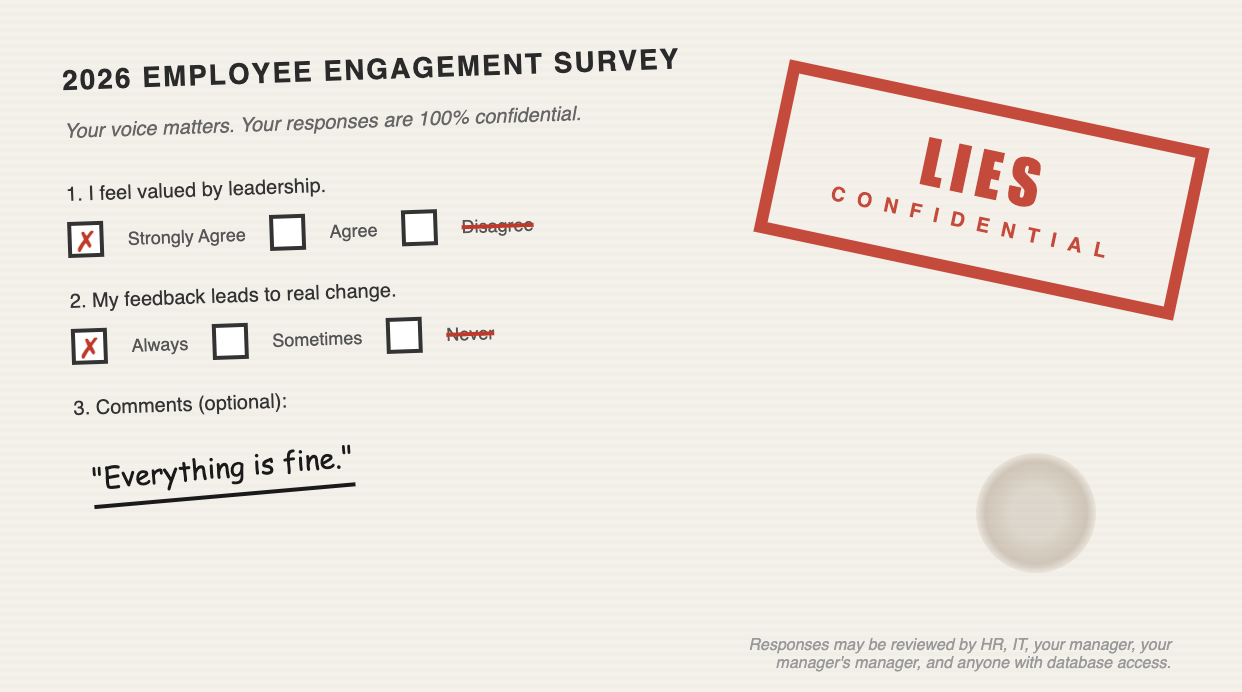
Employee surveys have become one of modern management’s most successful cons: a mechanism that allows companies to claim they value employee feedback without the messy commitment of actually acting on it. They’re the organizational equivalent of “thoughts and prayers”—a gesture that costs nothing, demands nothing, and accomplishes nothing beyond allowing leadership to check a box labeled “employee engagement.” The real purpose isn’t gathering honest feedback. It’s creating plausible deniability. When employees complain about problems, management can point to the survey and say, “We asked, and you didn’t tell us.” Except employees did tell them. They just weren’t listening.
The Confidentiality Myth
The foundation of every employee survey is a promise: your responses are confidential, anonymous, protected. This promise is a lie, and everyone knows it.
Employees understand how data works. They know that “anonymous” surveys still collect metadata—timestamps, IP addresses, device information. They know that when results are broken down by department, location, or tenure, the pool gets small enough to identify individuals. Work in a three-person satellite office? Your “anonymous” feedback might as well have your name on it. Gave the only negative score in your ten-person team? Congratulations, you’ve just identified yourself.
The confidentiality illusion crumbles further when employees watch how information flows through organizations. They notice when a critical comment in Monday’s survey becomes Tuesday’s closed-door meeting. They observe which employees get quietly managed out after particularly honest feedback cycles. They remember the manager who, during a team meeting, referenced specific survey language that was supposedly anonymous. The message becomes clear: confidentiality is a legal fiction, not a practical reality.
Even in larger organizations where true anonymity might be technically possible, employees have learned not to trust the system. They’ve seen too many “anonymous” feedback sessions where leadership somehow knew exactly who said what. They understand that HR systems log everything, that IT can trace anything, and that “we can’t see individual responses” often means “we can’t see them easily” rather than “we can’t see them at all.”
This knowledge poisons the entire exercise before it begins. Employees approach surveys not as opportunities for honest dialogue but as potential minefields where one wrong answer could mark them as “not a team player” or “resistant to change.” The survey becomes a test of political savvy rather than a genuine feedback mechanism.
Contaminated Data, Useless Results
When employees don’t believe they’re protected, they cannot give honest feedback. It’s that simple. The result is data so thoroughly contaminated by self-censorship and strategic dishonesty that it’s worthless for any meaningful purpose.
Watch employees fill out surveys and you’ll see the calculation happening in real time. They hover over the rating scale, considering not what they actually think but what’s safe to say. That question about management effectiveness? Better give it a 4 out of 5—not so high it looks like brown-nosing, not so low it looks like troublemaking. The open-ended question about workplace challenges? Write something vague about “communication” or “work-life balance,” nothing specific enough to be traced back, nothing honest enough to be useful.
The gap between survey responses and reality becomes obvious in any honest workplace conversation. At lunch, employees will tell you exactly what’s broken: the incompetent director everyone tiptoes around, the promotion system that rewards politics over performance, the “optional” weekend work that’s actually mandatory. But in the survey? Suddenly everything is “generally satisfactory” with “room for improvement.” The survey captures the corporate-approved version of employee sentiment—sanitized, safe, and completely divorced from truth.
This creates a perverse feedback loop. Leadership receives data showing that employees are reasonably satisfied, with only minor concerns about standard workplace issues. They conclude that no major changes are needed. Meanwhile, employees know they lied on the survey, see that nothing changed, and learn that honesty is neither expected nor rewarded. The next survey cycle produces even more filtered, even less useful data.
Where Survey Results Go to Die
Even if surveys somehow captured honest feedback—and they don’t—it wouldn’t matter. Because survey results don’t drive change. They drive PowerPoint presentations.
The journey is predictable. Results are compiled, analyzed, and transformed into a deck with lots of charts showing mostly positive trends. HR presents these findings to leadership in a meeting where everyone nods seriously and commits to “taking this feedback seriously.” Someone suggests forming a committee. Someone else proposes “further analysis.” The deck gets filed away, and everyone returns to business as usual.
Leadership engages with survey data selectively, treating it like a buffet where they take what they like and ignore the rest. Results that confirm existing priorities get cited repeatedly: “As the survey shows, employees value professional development,” says the executive who already planned to expand training programs. Results that challenge leadership decisions get dismissed: “The sample size for that question wasn’t statistically significant,” or “We need to understand the context better before acting on that feedback.”
Actionable criticism simply disappears. Employees report that their manager plays favorites? That’s a “personnel matter” that can’t be discussed. Multiple teams flag that the new software system is dysfunctional? “We’ve invested too much to change course now.” Widespread concern about unsustainable workloads? “We’re all doing more with less in this economy.”
The most damning evidence of leadership’s disinterest is what happens when employees ask about survey results. Months pass. Employees inquire. Eventually, they get a vague email about “positive trends” and “areas of focus” that could have been written without ever looking at the data. Specific problems raised in surveys are never mentioned. Concrete changes are never announced. The message is clear: we asked because we had to, not because we cared.
The Cycle of Cynicism
Each survey cycle that produces no meaningful change teaches employees a lesson: their feedback doesn’t matter. This lesson accumulates, deepening with each repetition until cynicism becomes the default workplace attitude.
Employees learn to game the system. They figure out the minimum acceptable scores to avoid triggering concern. They master the art of the meaningless comment: specific enough to look engaged, vague enough to be safe. They participate because participation is tracked and non-participation raises flags, but they participate without hope or honesty.
The tragedy is that this makes surveys even more useless, which gives leadership even more reason to ignore them, which makes employees even more cynical. It’s a self-perpetuating cycle of meaninglessness, and everyone involved knows it. Yet companies keep running surveys, keep promising that “this time will be different,” keep insisting that employee voices matter.
They don’t. The surveys prove it every year. And employees have learned to stop believing otherwise.