
The Annual Performance Review
A Masterclass in Corporate Bullshit

It’s that magical time of year again. No, not the holidays. Not your birthday. It’s time for your annual performance review—that sacred corporate ritual where you spend hours documenting everything you did over the past twelve months so your manager can skim it for five minutes before your thirty-minute meeting where absolutely nothing of consequence will be discussed.
You know it’s bullshit. Your manager knows it’s bullshit. HR definitely knows it’s bullshit. And yet here we all are, gathered around the glowing altar of the performance appraisal system, pretending this exercise measures something real. It’s like we’ve all agreed to participate in an elaborate play where everyone has memorized their lines but nobody believes the plot.
The performance review is corporate theater at its finest—a Kabuki dance of self-assessment, goal-setting, and feedback that exists in a parallel universe where words like “synergy” and “impact” actually mean something.

It’s a system that measures nothing, develops nobody, and exists purely because... well, because it exists. And that’s apparently reason enough.
The Great Copy-Paste Renaissance
Let me walk you through how this actually works, because the gap between what companies think happens and what actually happens is wider than the Grand Canyon.
Step one: You open last year’s performance review document. This is crucial. Why reinvent the wheel when you literally did the same job you did last year?
Step two: You copy your task list. All of it. “Managed stakeholder relationships.” “Delivered quarterly reports.” “Participated in cross-functional initiatives.” It’s all still true! You’re still doing these things! In fact, you’ll probably be doing them next year too, which is great because you can copy-paste this document again in twelve months.
Step three—and this is where the real artistry comes in—you add the magic words. You didn’t just “send emails,” you “facilitated strategic communications across multiple business units.” You didn’t “attend meetings,” you “drove alignment on key organizational priorities.” You didn’t “do your job,” you “delivered measurable impact on critical business outcomes.”
What impact? Doesn’t matter. The system doesn’t actually measure impact. It measures your ability to claim impact using the right vocabulary. It’s like Mad Libs for corporate drones: “I [action verb] the [buzzword] which resulted in [vague positive outcome] for the [business unit].”
The beautiful thing about this system is that it rewards creativity in exactly one area: your ability to make mundane work sound like you personally saved the company from bankruptcy. You answered customer service emails? No, you “enhanced customer experience through responsive, solutions-oriented engagement.” You fixed a bug in the code? Wrong. You “improved system reliability and user satisfaction through proactive technical intervention.”
Everyone knows this is what’s happening. Your manager knows you’re inflating routine tasks into strategic achievements. You know your manager did the same thing on their review. It’s bullshit all the way up and all the way down. But we’ve all agreed to pretend that this document—this carefully crafted work of fiction—represents an accurate assessment of your performance.
Personal Development: The Goals You’ll Never Achieve (And Nobody Cares)
But wait, there’s more!

You can’t just document what you did. You also have to set personal development goals for the coming year.
This is my favorite part of the whole charade, because it’s where the system’s dishonesty becomes most naked.
Your company wants you to identify areas for growth. They want you to set ambitious learning objectives. They want you to demonstrate commitment to continuous improvement. What they don’t want to do is give you time to actually develop those skills, or money to take courses, or any meaningful support whatsoever.
So you write something like “Develop advanced data analysis skills” or “Improve public speaking abilities” or “Learn Python.” And then... nothing happens. Because you have a full-time job doing the things you already know how to do. Because the training budget was cut. Because your manager has no idea how to help you learn Python and frankly doesn’t care if you do.
But next year, when you’re filling out this form again, you’ll need to address these goals. So you’ll write something vague about “making progress” or “seeking opportunities to apply these skills” or—if you’re feeling honest—you’ll just delete them and write new goals you also won’t achieve.
The company doesn’t actually want to develop you. If they did, they’d have a development program. They’d have mentorship. They’d have training. They’d have managers who give a shit. What they want is for you to perform the ritual of self-improvement, to demonstrate that you’re the kind of person who thinks about growth, even though the system provides zero support for actual growth.
It’s personal development as performance art. You’re not supposed to actually grow. You’re supposed to write down that you want to grow, in the correct format, using the approved language. The goal isn’t development. The goal is documentation that you thought about development.
The System Exists Because the System Exists
Here’s the thing that really gets me: nobody thinks this works.
I’ve never met anyone—not one single person—who believes the annual performance review system effectively measures performance, drives development, or improves outcomes. Not employees. Not managers. Not HR professionals. Not executives.
Everyone knows it’s broken.
So why does it persist?
Because the machinery exists. Because there’s a form. Because there’s a process. Because there’s a database somewhere that stores all these reviews. Because changing it would require admitting it never worked in the first place, and that’s a level of institutional honesty most companies simply cannot handle.
It’s easier to keep running the broken machine than to turn it off and ask hard questions like “What are we actually trying to accomplish?” or “Is there a better way to do this?” or “Why are we doing this at all?”
The system perpetuates itself through sheer inertia. It’s a corporate zombie—dead but still walking, consuming resources and time, serving no purpose except its own continuation.

We feed it our hours and our bullshit because that’s what the system requires, and the system requires it because... well, because it always has.
This is how broken systems survive in organizations. Not because they work. Not because anyone wants them. But because dismantling them would require someone to stand up and say “This is stupid and we should stop,” and that kind of honesty is career suicide.
So we keep the system. We keep filling out the forms. We keep having the meetings. We keep pretending it means something. And the system keeps existing, justified by nothing except its own existence.
What We’re Not Measuring (Everything That Matters)
Let’s talk about what the annual performance review actually measures.
Does it measure competency? No. Your manager sees you work every day. They already know if you’re competent. The review doesn’t reveal anything new about your abilities.
Does it measure growth? Absolutely not. Growth happens continuously, in small increments, through daily work and challenges. A once-a-year snapshot captures none of that. It’s like trying to understand a movie by looking at a single frame.
Does it measure your actual impact on the company? Not even close. Real impact is complex, often collaborative, and hard to attribute to individuals. But the review form needs you to claim individual impact, so you do, even though you know it’s a simplification bordering on fiction.
Does it measure whether you’re getting better at your job? No. It measures whether you can remember what you did and describe it in favorable terms.
What the system actually measures is:
Your ability to document your work in the approved format
Your skill at corporate language and buzzword deployment
Your willingness to participate in organizational theater
Your compliance with bureaucratic processes
In other words, it measures bullshit. It measures your ability to bullshit convincingly, in writing, once a year.
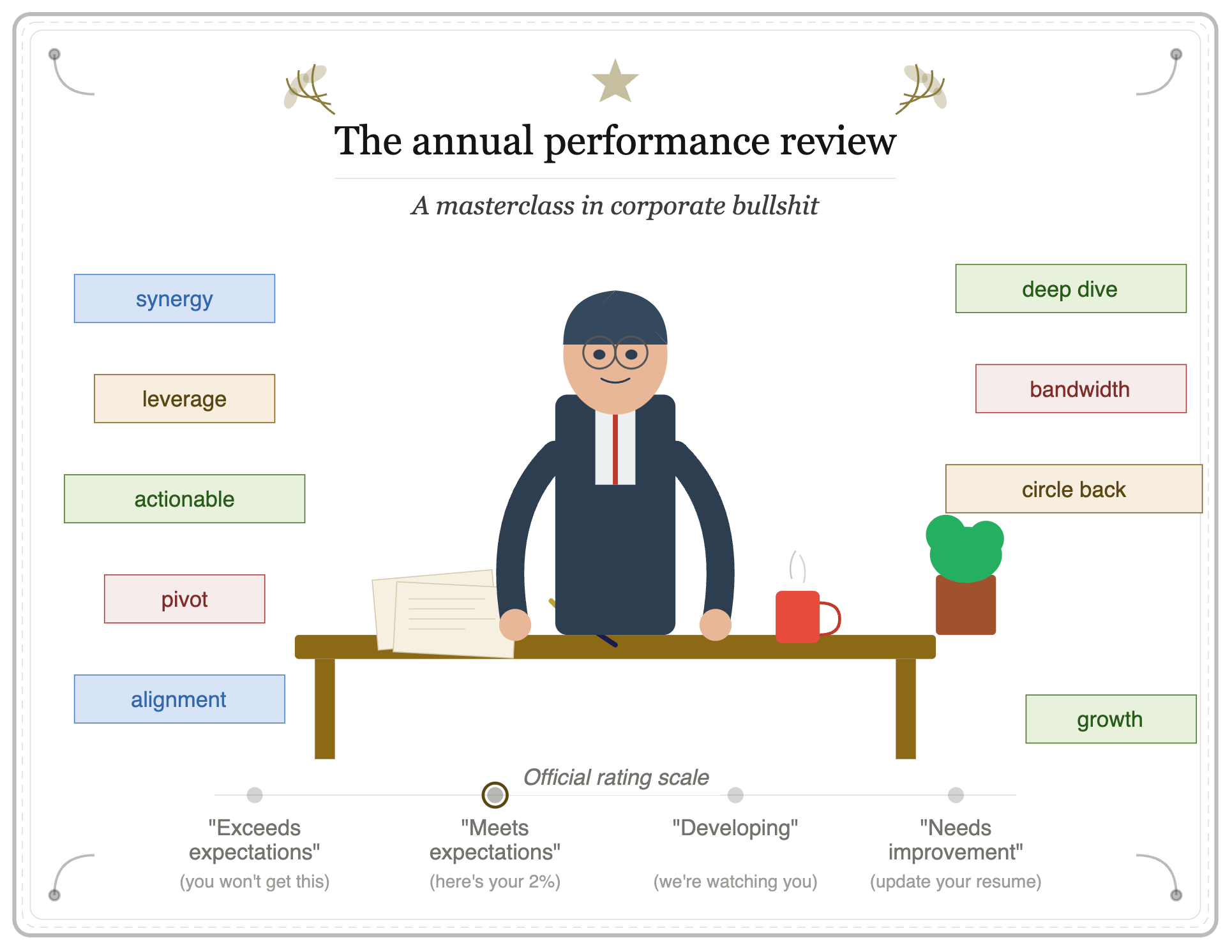
The things that actually matter—Are you solving real problems? Are you helping your team succeed? Are you learning and adapting? Are you making good decisions under pressure?—none of that shows up in the performance review. It can’t. The system isn’t designed to capture actual performance. It’s designed to generate documentation that the company performed performance management.
The Feedback That Never Comes
Here’s the cruelest irony of all: the performance review system is supposedly about feedback and development.
The whole point—the stated purpose, the justification for this entire apparatus—is to help employees understand how they’re doing and how they can improve. It’s meant to be a tool for growth.
But here’s what actually happens: You work for twelve months. During those twelve months, if you’re lucky, you get occasional vague comments from your manager. “Good job on that project.” “Thanks for handling that.” Maybe, if something goes really wrong, you get a tense conversation.
But real feedback? Honest, specific, actionable feedback about what you’re doing well and what you could do better? That doesn’t happen. Not regularly. Not continuously. Not in the moment when it would actually be useful.
Then, once a year, you sit down for your review. And if there’s critical feedback—if there’s something you should have been doing differently—you’re hearing it for the first time, twelve months too late to do anything about it.
Or worse: there’s no critical feedback at all. Everything is fine. You “meet expectations.” You get your 3 out of 5 or your “satisfactory” rating. And you leave the meeting with absolutely no idea what you should do differently, what you should keep doing, or what actually matters to your manager.
The system that’s supposed to provide feedback provides no meaningful feedback. The process designed to support development supports no actual development. It’s a feedback system with no feedback, a development process with no development.
If you wanted to design a system that actively prevented good feedback, you couldn’t do much better than the annual performance review. It’s too infrequent to be relevant. It’s too formal to be honest. It’s too tied to compensation to be developmental. It’s too focused on documentation to be conversational.
It’s everything feedback shouldn’t be, packaged as a feedback system.
The Dishonesty We Won’t Name
So here we are. A system that measures nothing. Develops nobody. Provides no useful feedback. Exists purely for its own sake. And costs thousands of hours of collective time across every company that uses it.
Why do we keep doing this?
Because naming what’s broken requires honesty that most organizations simply don’t have. It requires someone to say out loud what everyone already knows: this doesn’t work, it never worked, and we’re all just going through the motions.
It requires admitting that we’ve built elaborate systems that serve no purpose except to create the appearance of management. That we’ve institutionalized bullshit and called it performance management. That we’re asking people to waste their time on theater because we’re too cowardly to admit the theater is pointless.
But everyone knows. You know. Your manager knows. HR knows. The executives know. We’re all in on the secret: this is bullshit.
The question is: how much longer are we going to pretend it isn’t?